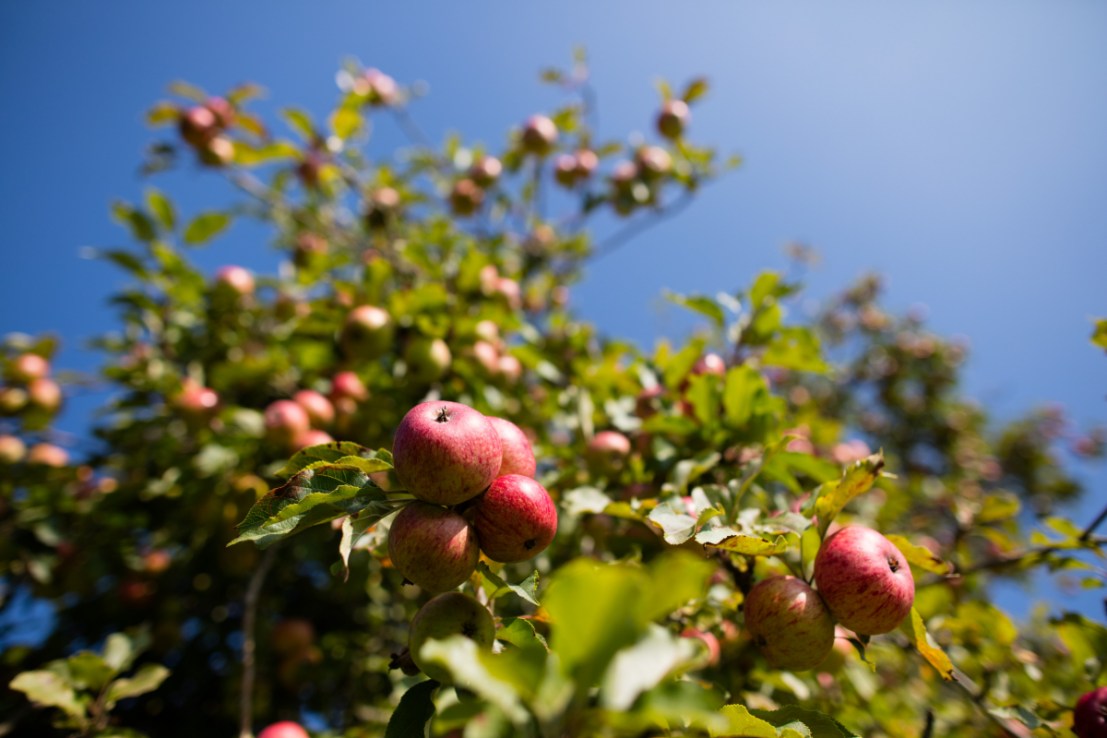
The Somerset Cider Brandy Company claims to produce the most sustainable spirit in the UK, a bold statement, given the range and variety of products on the market.
However, as managing director, Matilda Temperley tells City AM, apple trees, in particular cider apple trees, are one of the most environmentally friendly crops on the planet. The crop rotation of an apple tree can extend to 100 years and cider orchards, if farmed with no pesticides, are considered priority habitats.
The Somerset Cider Brandy Company ferments and bottles all its products on site, using 75 per cent recycled glass in its bottles. As a result, the entire process, from planting saplings to selling the product at the farm gate, has a remarkably low environmental impact.
The company’s sustainability efforts were recognised this year at the Golden Fork Awards, the annual awards ceremony for The Guild of Fine Foods. The Somerset Cider Brandy Company won the Golden Fork Award for Better Business, celebrating the Temperley family’s work protecting the farm and the environment over generations.
Generational work and Golden Forks
The Temperley family arrived at Burrow Hill in the 1960s, taking over as stewards of the farm’s 300-year-old cider-making legacy.
Julian and Diana Temperley founded the business on one simple principle: ‘If we don’t grow it, we don’t make it’. In practical terms, the harvest volume always dictates production because the family won’t buy in any extra product to meet demand.
This year, Burrow Hill and its orchards have collected a bumper crop. It has harvested a “massive” 1,000 tons of apples so far this year, nearly three times as much as the 350 tons harvested in 2024.
In terms of Brandy production, this year’s harvest is expected to yield approximately 70 barrels of spirit, what Matilda calls a “good year” compared to only 10 barrels last year.
The commitment to only using what’s grown on the farm means Matilda and her team need to be prudent when planning production runs. The cider brandy spirit needs to age for 12 years before it can be sold, so smaller harvests can have a knock-on effect on long-term supply.
Still, the Somerset Cider Brandy Company is committed to this low-impact, homegrown approach. When Julian and Diana started the cider brandy brand, “there was no market” for small artisan spirits, Matilda explains.
The sector was dominated by huge industrial whiskey and gin, and products like Smirnoff were considered “posh vodka in supermarkets”. But they didn’t set up the brand to make money. The project was based “absolutely not on any commercial sense at all,” but rather driven by the desire to diversify and out of “sheer bloody-mindedness,” she explains.
The commitment to quality and sustainability has been recognised at the Great Taste awards. As well as the Golden Fork Award for Better Business, the company’s Somerset Pomona (a blend of apple brandy and juice), Morello Cherry Liqueur (Apple Eau de Vie infused with Somerset Morello cherries), and Elderflower liqueur have all won the highest three-star Great Taste Award.
Fending off the competition
There’s a real passion and commitment among the UK’s artisan and family-owned food and drinks producers. However, these producers are suffering under the weight of government regulation, taxes and red tape.
The total acreage of cider orchards in the country has fallen by around seven per cent in the past three years, but the volume of cider sold remains “more or less similar”, Matilda explains.
To fill the gap between cider demand and apple production, big producers have shifted to imported concentrate, a “real tragedy in the industry”, says Matilda.
These large producers market their products around the “romance of English orchards” while fruit is often sourced unsustainably from abroad, countries such as Chile and supplied as concentrate.
Producers have also pushed down the apple content to such a low level that cider is essentially just industrial alcohol and flavourings with high sugar content, which should arguably be labelled as an “alcopop” rather than cider, argues Matilda. These products are cheaper to make because the sugar “fulfils lots of the role of flavour”.
Cider makers have been able to get away with this shift following a 2010 rule change that stipulated a minimum of 35 per cent apple (or pear) juice content is required for a product to be labelled ‘cider’.
Industry bodies such as the Campaign for Real Ale (CAMRA) and various apple growers have called for the minimum juice content to be raised to 50 per cent, or even 90 per cent, to improve quality and support British orchards.
Against this backdrop, the Somerset Cider Brandy Company’s low-impact, homegrown approach is a powerful defence against poor-quality ‘alcopop’ rivals and awards like the Golden Fork are becoming “ever more important” to help consumers “differentiate between the marketing noise and the reality” of a product, especially for smaller producers.
The Guild of Fine Food, is a community for business owners with a shared commitment to producing and promoting excellent food & drink. Formed to provide mutual support and protection in maintaining standards and raising awareness of quality, it represents independent businesses at local, national, international and governmental levels; building a diverse and inclusive collective of producers, retailers and food lovers.
The Guild runs the most highly respected food and drink accreditation schemes in the world, Great Taste and the World Cheese Awards. It also publishes industry leading magazines Fine Food Digest, Good Cheese and the annual Great Taste Book.