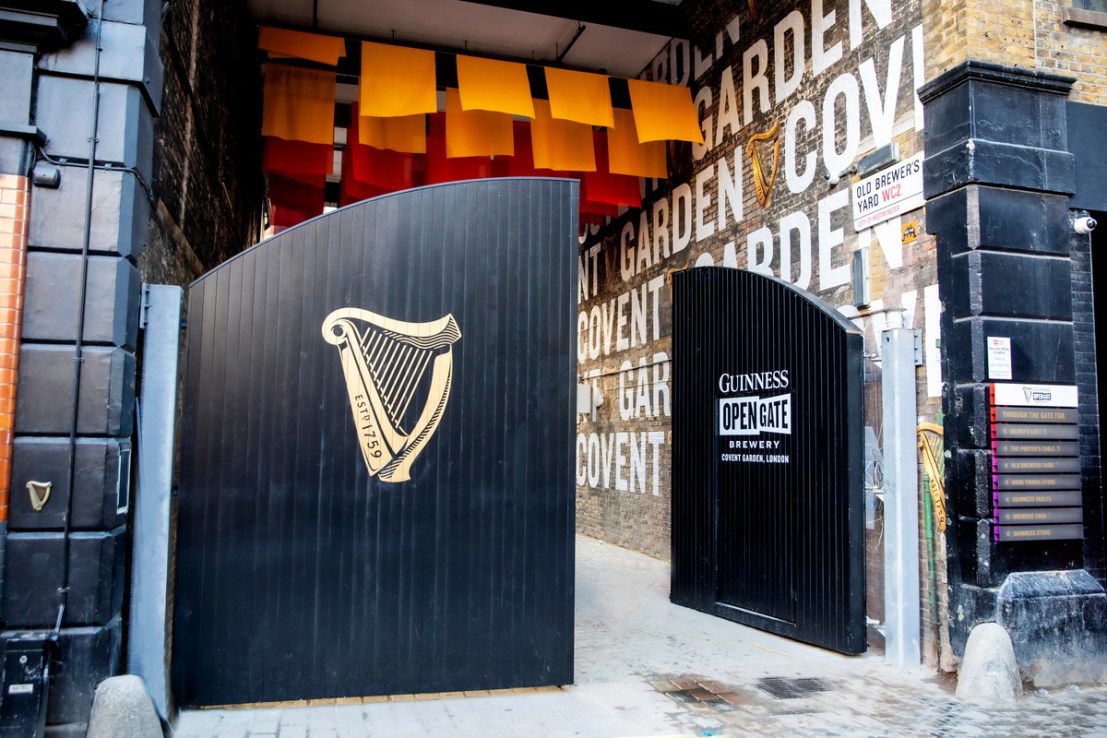
Guinness has opened its fifth brand home in the heart of London as it hopes to capitalise on the growing popularity of the ubiquitous Irish stout.
The mammoth £73m project in the middle of Covent Garden, which has taken six years to go from inception to completion, will see brewing return to the area for the first time in over 300 years.
Six different beers will be brewed at the site, including two rotating seasonal beers – at its opening, the two beers were a cinnamon winter warmer and an apricot sour – although it will not see any Guinness production on site.
The brewing of the black stuff will remain at St James’ Gate in Dublin, where its recipe relies on water sources from the nearby Wicklow mountains.
The Covent Garden site is also much smaller than its Irish sibling. St James’ daily production produces three million pints, whereas this location will only brew around 750,000 pints a year.
The production room at Covent Garden. Credit: Diageo
The London microbrewery, which can accommodate just 350 visitors at one time, will offer tours of the production floor, as well as shops, tastings and the opportunity to visit two on-site restaurants.
Guinness bets on brand appeal
The Guinness brand has exploded in the last year, helped by the TikTok virality of ‘splitting the G’ and a post-pandemic push towards nostalgia.
Orders were so high last Christmas that Diageo had to raid its Irish storehouse to supply some pubs in the capital, which had run dry (some were reduced to offering Guinness ration cards).
“We’ve seen phenomenal performance on Guinness,” Gráinne Wafer, director of beer, liqueur & vodka at parent company Diageo said. “We’re seeing a massive increase of women and younger people coming into the brand.”
But its success over the last year has been a long time coming: Founded in 1759 by Arthur Guinness when he signed his famous 9,000-year lease for the St. James’s Gate Brewery, the company has slowly grown its brand appeal using sports partnerships and, crucially, its brewery experiences.
The Guinness storehouse in Dublin has welcomed over 28m visitors since it opened 25 years ago, with a quarter of all international visitors to Ireland going. In fact, every fifth visitor tastes their first ever pint of Guinness at the brewery.
“It’s an important way of welcoming people to the Guinness experience,” Wafer said.
“We see [brand homes] as a very important part of bringing people closer to the history, the heritage, the craft, and, of course, the modern expression of our brands.”
The new Covent Garden site, meanwhile, has a goal of over half a million visitors in its first year.
The new site has two restaurants. Credit: Diageo
Wafer said that the Covent Garden site signals the “next chapter” in Guinness’ push for international exposure.
But as the black stuff becomes ever-more popular, there’s increasing competition from other Stout-makers like Beamish and Samuel Smith.
There’s also the chance that the in-vogue Guinness falls foul of the notoriously fickle online trends which have fuelled its 2025 boom.
But Wafer brushed off concerns that Guinness faces contenders to its stout crown, pointing out that around a third of Brits who consume alcohol directly prefer beer, while only five per cent favour Stout.
“The [Guinness] brand has momentum” and “continue[s] to have headroom,” she said.
Diageo bets on Guinness
The continuing star performance of Guinness is crucial for its parent company Diageo, which was formed by a merger of Guinness and hospitality and distribution conglomerate Grand Metropolitan.
The stout – and its zero-alcohol cousin – continues to be the fastest-growing segment at the behemoth alcohol producer, which has been struggling with a slowdown in the global spirits trade.
In its latest results, Diageo told markets that Guinness sales grew 13 per cent year on year, with the stout’s performance heading up the first page of its yearly financial report.
“Guinness continues to be incredibly successful and is confirming its role as Diageo’s flagship brand,” Matt Dorset, equity research analyst at Quilter Cheviot, said.
In 2024, speculation about a potential £6bn sale was quickly dismissed, with Guinness’s strong growth reportedly vital to the company.